Server hardening

Lynis - Security auditing and hardening tool for Linux/Unix
Lynis is an open source security auditing tool. Part of Lynis Enterprise Suite, its main goal is to audit and harden Unix and Linux based systems.
 CISOfy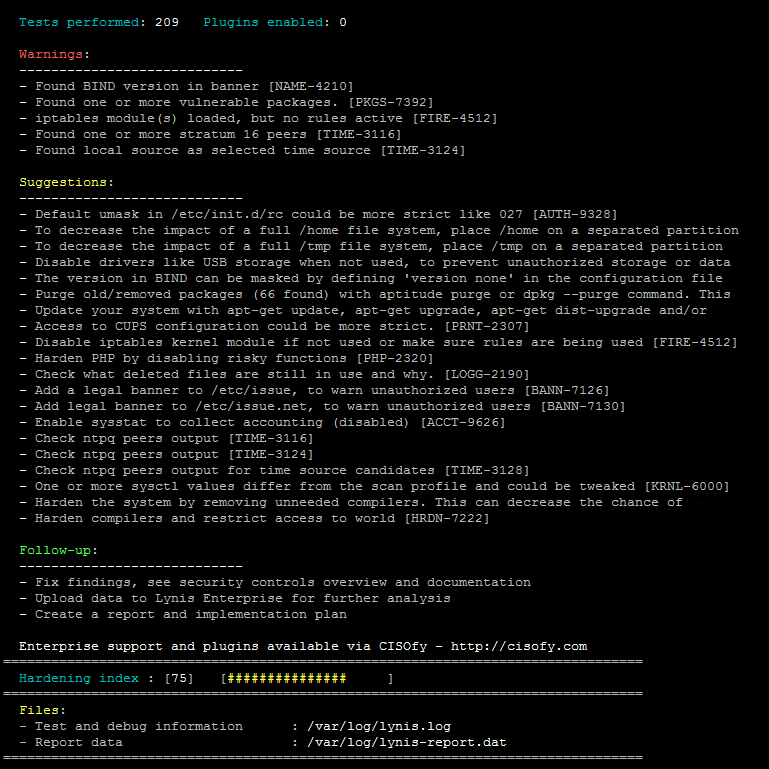
Ubuntu Server Security Best Practices (Derived from Top GitHub Projects)
Executive Summary
Across popular Ubuntu-centric security projects—hardening roles, auditing tools, firewalls, intrusion prevention, and CIS implementations—the most consistent practices are: keep a tight patch cadence with auto-security updates; minimize the attack surface; lock down SSH; enforce host-level firewalling (mind Docker interactions); add active abuse prevention (e.g., Fail2Ban/CrowdSec); baseline against CIS/DevSec; audit continuously (Lynis/ssh-audit); and log/monitor aggressively.
Corpus (10 GitHub Projects)
- dev-sec/ansible-collection-hardening — battle-tested hardening for Linux/SSH/nginx/MySQL aligned to DevSec baselines.
- konstruktoid/hardening — opinionated Ubuntu hardening (systemd), tested on 20.04/22.04.
- CISOfy/lynis — on-host security auditing with hardening guidance.
- fail2ban/fail2ban — log-driven bans for brute-force/abuse; ships with SSH/Apache jails.
- mvo5/unattended-upgrades — automatic installation of security updates on Debian/Ubuntu.
- jtesta/ssh-audit — audits SSH server/client algorithms & config, with hardening hints.
- crowdsecurity/crowdsec — crowdsourced detection & community blocklists; agent + bouncers.
- UFW — uncomplicated firewall (iptables/nftables frontend).
- ansible-lockdown/UBUNTU22-CIS — automates CIS Ubuntu 22.04 LTS Benchmark controls.
- canonical/ubuntu-server-documentation — official Ubuntu Server docs (baseline procedures).
(Note: Docker can bypass UFW unless specifically handled; see ufw-docker guidance.)
Best Practices
1. Patch Management
- Enable automatic security updates with
unattended-upgrades. - Keep mirrors healthy; verify after incidents.
sudo apt-get update && sudo apt-get install unattended-upgrades apt-listchanges
sudo dpkg-reconfigure -plow unattended-upgrades
2. Minimize Attack Surface
- Remove unused packages/services.
- Apply secure sysctl and filesystem options.
3. SSH Hardening
- Disable root login and password authentication.
- Enforce strong ciphers, MACs, KEX.
- Validate with ssh-audit.
# /etc/ssh/sshd_config.d/10-hardening.conf
PermitRootLogin no
PasswordAuthentication no
KexAlgorithms curve25519-sha256,curve25519-sha256@libssh.org
MACs hmac-sha2-512,hmac-sha2-256
4. Firewalling
- Enable UFW with default deny inbound, allow outbound.
- Handle Docker bypass properly.
sudo ufw default deny incoming
sudo ufw default allow outgoing
sudo ufw allow OpenSSH
sudo ufw enable
5. Abuse Prevention
- Configure Fail2Ban jails.
- Use CrowdSec for community-driven IP reputation.
6. Compliance & Baselines
- Apply CIS Ubuntu or DevSec baselines via Ansible.
- Tailor exceptions as needed.
7. Continuous Auditing
- Run Lynis regularly.
- Pair with ssh-audit for SSH.
8. Logging & Monitoring
- Persist and centralize logs.
- Ensure logrotate hygiene.
9. Secrets & Least Privilege
- Restrict sudo and enforce granular privileges.
- Apply AppArmor profiles.
10. Web & Reverse Proxy Hardening
- Harden TLS/cipher suites.
- Remove unused nginx modules.
Secure-by-Code
Codify hardening and auditing in Ansible/Terraform pipelines.
Validate post-boot with Lynis & CIS checks.
Starter Runbook (Ubuntu 22.04/24.04 LTS)
- Patch & reboot: unattended-upgrades + weekly reboots.
- Baseline hardening: apply
dev-sec/ansible-collection-hardening. - SSH lockdown: keys only, validate with ssh-audit.
- Firewall: UFW default-deny + Docker-aware config.
- Abuse prevention: Fail2Ban + CrowdSec.
- Compliance: CIS audits.
- Logging: journald persistence + central log shipping.
- Docs: maintain ops runbooks.
References
- dev-sec/ansible-collection-hardening
- konstruktoid/hardening
- CISOfy/lynis
- fail2ban/fail2ban
- mvo5/unattended-upgrades
- jtesta/ssh-audit
- crowdsecurity/crowdsec
- UFW project
- ansible-lockdown/UBUNTU22-CIS
- canonical/ubuntu-server-documentation
- ufw-docker guidance